Your Entity Structure Has Layers. Your Reporting Should Too.

As companies grow, so do their entity structures. International subsidiaries. Regional holding companies. Acquisitions that bring their own legal entities into the mix.
For finance teams managing these structures, the problem isn't understanding the hierarchy—it's that your ERP doesn't. You know you have a tree, but your system thinks you have a flat list, so you end up with more Excel tabs, more manual consolidation workpapers, and a close process that gets harder each time you add a new entity.
Multi-Entity Hierarchy is now live in Rillet. It’s a full tree-structured consolidation across all your financial reports, with ASC 830-compliant FX translation applied at every level, automatically. Go beyond top-level reporting and drill down to every level of the hierarchy—it’s the difference between increasing difficulty and easy answers.
Reporting at any node in the tree
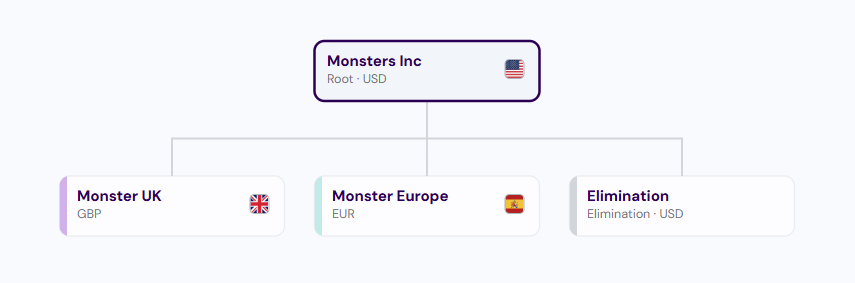
With Multi-Entity Hierarchy, you model your entity structure as it actually exists: a tree, where subsidiaries roll up into intermediate parents before consolidating at the top. You model the structure once, and Rillet handles the rest.
Take a structure like this:
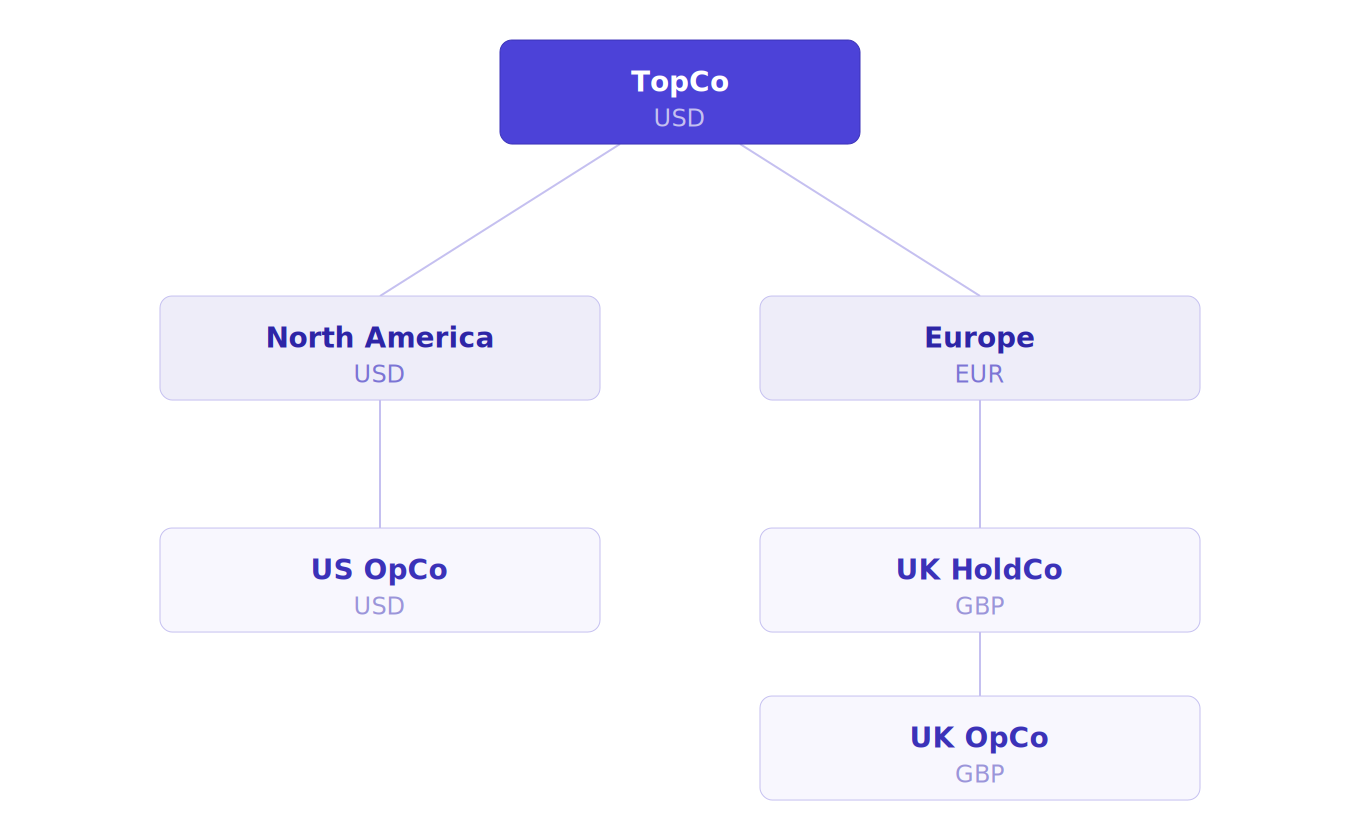
You can now run any financial report at any node in that tree. Select an entity, choose individual or consolidated, and Rillet gives you the right view:
- UK OpCo: Standalone, just that entity in GBP
- UK Holdco consolidated: Holdco plus OpCo, with intercompany eliminations applied between them, in GBP
- Europe consolidated: The full European group in EUR, with FX translation level by level
- TopCo consolidated: The complete picture in USD, with all eliminations and translations applied correctly throughout the chain
Every consolidated view runs in the reporting currency of the entity you select. Eliminations are scoped correctly at each level; a sub-consolidation only eliminates intercompany transactions within that group, not across the whole tree.
FX translation done right, at every level
Multi-currency consolidations require FX translation to be applied level by level, versus shortcut from local currency straight to the top. Per ASC 830, each entity in the chain has its own functional currency and foreign exchange exposure that must be recognized at that level.
We do this for you, automatically. A transaction that originates at $1,000 USD might translate to €840 EUR at the intermediate level, and then to ~$999.52 USD at the top. That's the correct, compliant application of the standard. Every consolidated view reflects ASC 830 accurately, so what you will see in the report matches what your auditors will expect to see in the workpapers.
This also means the Cumulative Translation Adjustment (CTA) is calculated correctly at each level and is drillable. CTA is a plug-in for almost every ERP by design — because the underlying calculation is genuinely complex. We built it to be transparent: you can trace how the adjustment was computed, which means you can show your work to auditors. That matters when you're in the middle of an audit or preparing for one.
Every core financial report, across the full hierarchy
All six core reports now run at the individual entity level and at any consolidated level in your tree:
- Trial Balance
- Income Statement
- Balance Sheet
- General Ledger
- Cash Flow Statement
- Executive P&L
The General Ledger report adds per-entity columns in consolidated views, so you can see each subsidiary's contribution alongside the consolidated total in a single report. No need to mess about toggling between views or exporting to a spreadsheet to piece it together.
Built to accommodate real complexity
We spent time getting this one right. Multi-Entity Hierarchy was months in the making because we’ve designed it for the finance teams managing genuinely complex entity structures: PE-backed companies with regional holding structures, businesses that have grown through acquisition, and international operations with multiple functional currencies.
Our first customers using the new hierarchy are already live. They’re public, they need to provide financials to their board, and they (of course) require it to work correctly, not approximately. Multi-Entity Hierarchy is now formally rolling out and available to all Rillet customers.
Consolidation that reflects reality, not last night’s batch
Our architecture updates reports as transactions post. That’s it. No batch runs. No period-end recalculation jobs. No waiting until close to see where your consolidated numbers stand.
Multi-Entity Hierarchy is part of that same foundation. It’s consolidated reporting that reflects right now. FX translation computed at every level, eliminations scoped correctly, and CTA calculated and traceable. It’s the kind of output your auditors can actually rely on, and that you can actually use to run the business.
If your entity structure has complexity that your current system can't properly reflect, book time to see Multi-Entity Hierarchy in Rillet here.